
(TheBRHM.com) You could argue rock got knocked sideways by three guys who never asked for the job. Kurt Cobain and Krist Novoselic started Nirvana in Aberdeen, Washington, in 1987, and when Dave Grohl joined in 1990, the lineup that would crack the whole thing open was finally in place. The strange part is how much the group seemed to want out of its own success almost as soon as the success showed up. Fame chased them. Running the other way became something close to a full time occupation.
Aberdeen shaped Cobain long before any stage did. A logging town wrapped in grey skies and economic rot, the place offered little to a restless kid who felt out of step with the jocks and the timber culture surrounding him. Escape arrived through records. Buzz Osborne of the Melvins, older and already deep into hardcore, handed young Kurt a doorway into Black Flag, Flipper, and the ugly beauty of American underground noise. Those sounds mattered more than any arena spectacle beaming in from Los Angeles.
What separated this crew from the reigning powers of 1980s metal was philosophy as much as volume. Consider the landscape at the time. Sunset Strip glam ruled MTV, all spandex and hairspray and choreographed decadence. Poison and Mötley Crüe and the rest of that pack were selling a fantasy, one long party with confetti falling on cue. Where Nirvana came from looked nothing like that. Their roots ran back through Portland’s Wipers, the sandpaper noise of Scratch Acid, the quiet loud tricks of the Pixies, and a straight up Beatles habit that Cobain never really hid, just buried under a ton of fuzz.
Bleach came out in 1989 on Sub Pop. The record cost a little more than $606 to make, and it sounds like it, murky and mean, a band still figuring out what it wanted to be. Touring meant a cramped van, greasy food, and clubs holding maybe forty sweating bodies. Small stages built the foundation. On those tiny platforms the band learned to weaponize dynamics, the hushed passage that suddenly erupts, a device Cobain openly admired in the Pixies and helped sharpen into a Nirvana signature.
Then September 1991 happened. Butch Vig produced Nevermind and Andy Wallace mixed it, and something about that combination worked far past what anybody planned for. The band figured a few college stations might bite. What they got was a monster. Kids latched onto “Smells Like Teen Spirit” like scripture, funny thing being most of them had no use for scripture of any kind. In January 1992, Nevermind did something almost nobody saw coming and knocked Michael Jackson’s Dangerous out of the No. 1 spot on the Billboard 200.
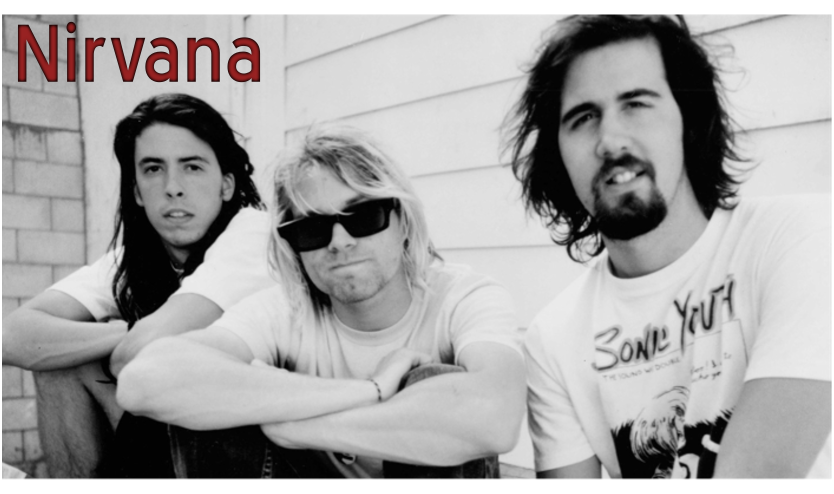
This is where things get weird. Instead of leaning into the spotlight, Cobain spent his stretch at the top swatting it away. He turned up on magazine covers in a beat cardigan and busted jeans while photographers were praying for a pinup. Interviews got spiky. A show would come apart right in front of the crowd now and then, all squeal and busted gear where the songs should have been, and Cobain wrecking a guitar not simply for the pose but because the whole traveling circus had clearly become something he struggled to live with.
In Utero showed up in 1993 sounding like a group that flat out would not give the people exactly what they ordered. Steve Albini recorded it raw and thorny, dry where you expected shine, harsh where a hit machine might have gone smooth. Label people worried about the sound, though the dispute was more complicated than executives against artists. Cobain and Novoselic had concerns about parts of the mix too, and Scott Litt was eventually brought in to remix “Heart-Shaped Box” and “All Apologies.” Even so, most of Albini’s abrasive approach stayed intact. Songs like “Rape Me” and “Heart-Shaped Box” made the larger point plain: going platinum had done little to soften the group’s taste for discomfort or loosen its grip on the underground code that raised it.
Then came the Unplugged taping in November 1993, and it showed a side of the group that big pop acts almost never risk. No parade of hits. What they played instead worked more like a reading list. That closing take on “Where Did You Sleep Last Night,” a traditional song famously associated with Lead Belly, ends on a scream that still feels like the room stopped breathing. There were three Meat Puppets songs in the set too, “Plateau,” “Oh, Me,” and “Lake of Fire,” with Curt and Cris Kirkwood joining the band, plus a spooky read of David Bowie’s “The Man Who Sold the World.” Point the crowd at your teachers instead of yourself, and you have done something most headliners never bother with.
Give Novoselic and Grohl their due here, because sideman is the wrong word for either one. Krist held the bottom down with this loose, rubbery bass feel, and he often served as the steadier presence inside a volatile band. Grohl went at the drums like the kit owed him money, and that pounding is exactly what made the soft then loud trick pay off the way it did. Take out that engine room and the songs slump into plain moping. Put it back and the whole thing turns into a controlled explosion.
Give it two or three years and the hair metal kingdom had basically fallen over. Suddenly every A&R guy in the business seemed to be hunting for something rougher, stranger, and less polished. Nirvana did not discover the Seattle scene for the record industry. Soundgarden and Alice in Chains had already landed major label deals before Nevermind exploded. What Nirvana did was blow the doors off commercially, turning an already growing Northwest movement into a national obsession and making alternative rock impossible for the industry to ignore. The taste of the whole country shifted, and you can trace a lot of that change back to one band that never seemed comfortable playing the role the business wanted from it.
Cobain died in April 1994, and the story quits running in a straight line after that. Folks reach for meaning in how it ended. There is this pull to take what was really a man in profound personal trouble and dress it up as some tragic beautiful thing. Skip that. The thing worth keeping is simpler and stranger than that. A pack of misfits who wanted little to do with velvet ropes and private jets changed rock because chasing that kind of ambition never seemed to be the point. Authenticity was the weapon. Honest songs, played by people who meant every note, outlasted every airbrushed rival of the decade. That is the quiet triumph still echoing through each kid who picks up a cheap guitar and decides the point was never the crown.
Staff Writer; Terry Poole
This brother brings sharp ears, deep respect, and real passion to every heavy metal riff, rock record, and overlooked gem he covers for TheBRHM… He writes for fans who still believe loud music should have soul, history, and meaning…
One may contact him at TerryP@TheBRHM.com.