(TheBRHM.com) Ask anyone raised on thrash which names carry weight and the answer arrives on cue. Metallica, Megadeth, Slayer, Anthrax. Those four names would eventually harden into thrash metal scripture and cling so tightly that whole legacies got graded against a club nobody ever held elections for. Parked just outside the velvet rope, never once sounding bruised about the snub, stood a Jersey unit sharpening its knives since 1980, one that refused to play like it was auditioning for approval. Overkill spent a career filed under trivia while the catalog deserved a chapter in the main text.
Feel the Fire arrived in 1985 and proved the venom was congenital rather than some pose learned later. “Rotten to the Core” became an instant pit anthem, all snarl and forward lunge. Blitz already sounded like an air raid siren fed through a switchblade, while D.D. Verni tracked a low end that clanked and growled up front instead of hiding behind the guitars. Raw as the production ran, the blueprint gleamed from the opening seconds.
Taking Over followed in 1987 and tightened every screw. “Wrecking Crew” plays like a mission statement, Blitz cackling that impossible high snarl while the rhythm section flattens whatever wanders into its lane. “Deny the Cross” rides one of the meanest bottom lines Verni ever committed to tape. “In Union We Stand” handed a crowd its chant without sanding off a single jagged edge. Records this sharp, cut this early, make it easy to forget that Overkill itself predates every member of the celebrated quartet, even if its first full length did not.
Under the Influence pushed the tempos harder still in 1988. “Hello from the Gutter” became the nearest thing these guys ever managed to an actual hit, all hook and grime and momentum. Speed alone never defined the appeal though. Songwriting muscle carried the disc, each cut engineered to stick rather than merely blur past.
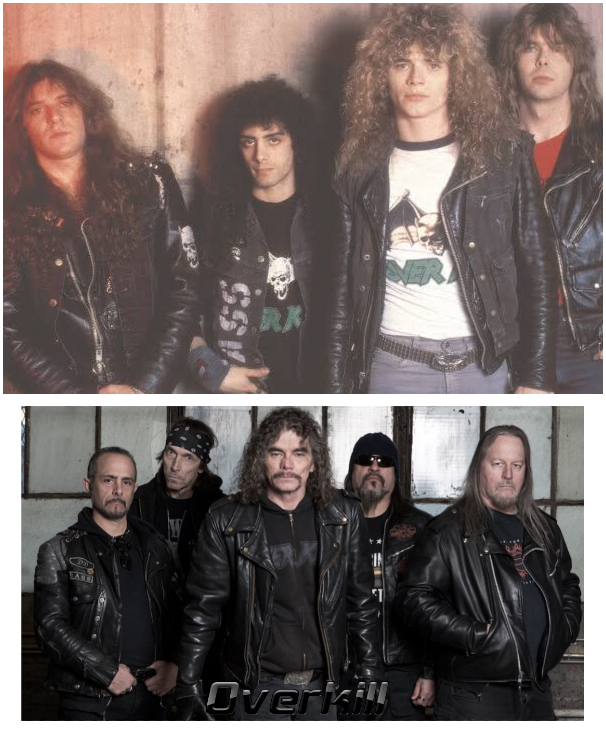
The Years of Decay settled the argument for good in 1989. Terry Date worked the console, the same hands working with Soundgarden around that period and soon to help shape Pantera’s breakthrough sound, and you can feel a real producer wrestling material this dense into shape. “Elimination” swings first, Bobby shrieking over a groove built to lurch and gallop at the same instant. Then the title cut unspools across eight minutes of slow poison nobody in the speed racket had the nerve to attempt. Peers couldn’t sit in a tempo that low without coming apart. This crew leaned all the way in and made patience feel threatening. “Playing with Spiders/Skullkrusher” pushes beyond ten minutes, dragging doom weighted menace through one of the most ambitious compositions Overkill had attempted. A statement carrying that much range belongs in the same sentence as anything the famous four shipped across that entire decade.
Horrorscope showed up two years later hauling a fresh problem behind it. Bobby Gustafson, the lone guitarist through the early run, had walked, so the founders rebuilt around a pair of players in Rob Cannavino and Merritt Gant. What might have gutted a weaker act instead thickened everything in earshot. Notice how “Coma” creeps in on that clean, ominous intro before it detonates. “Blood Money” churns with a measured swagger that predicted where a whole lot of nineties heavy music would eventually crawl. Its title track grinds along for nearly six minutes across shifting terrain, proof these musicians could compose rather than blast away. “Thanx for Nothin'” spits bile in barely over four. Front to back, that 1991 release stands taller than a fair chunk of what the celebrated names put out in the same window.
The stretch some fans skip past still holds real gold. I Hear Black arrived in 1993, divisive as anything in the discography, daring to slow the whole thing down and dabble in groove when doing so risked the faithful’s wrath. W.F.O. answered in 1994, opening with “Where It Hurts” and refusing to apologize for its bluntness. The Killing Kind sharpened the writing again in 1996. Not every gamble connected, sure, yet that willingness to risk is exactly what separates a working band from a nostalgia act.
Verni earns his own passage because that low end is the whole architecture. Most of the genre buried its bottom frequencies beneath six strings and let the bass merely keep time. Different rules applied here. His tone snarled out front, distorted and clanking, handling half the riffing while the leads screamed up top. Marry that to a voice pitched somewhere between a siren and a straight razor, and the result is a signature no rival ever quite copied. Blitz never leaned on melody the way Hetfield eventually would, never went operatic like Dickinson across the ocean. He simply sliced through any mix like rusted wire, and decades on he still nails those upper registers when younger throats have long since blown out.
The comeback nobody requested became the loudest argument of them all. Ironbound landed in 2010, opening with the eight minute “The Green and Black” before its six and a half minute title track came charging behind it. “Bring Me the Night” gallops with the fury of men who apparently never received the memo about slowing down. The Electric Age arrived in 2012 and somehow doubled the ferocity. White Devil Armory kept the streak breathing in 2014, then Scorched touched down in 2023 sounding meaner than material made by kids in their twenties. Feats like that, this late in a story, simply do not happen. Most veterans soften, coast, or vanish altogether. Overkill grew angrier and tighter as the calendar pages fell, which reads as its own quiet verdict on anyone still peddling the mythology of four.
So why did the barrier stay bolted? Timing and geography, mostly. Overkill lacked the crossover ballad and never turned its MTV exposure into the kind of mainstream breakthrough enjoyed by certain rivals, while refusing to chase the arena gloss that let other acts file down their menace for a wider paycheck. Purists read every bit of that as a badge worth wearing. A case exists, one worth making without apology, that loyalty to the form is precisely what kept this catalog honest while others sprinted toward radio and lost the plot entirely.
Line the discography up beside the canonized titles and the gap evaporates. The Years of Decay holds its ground against Rust in Peace or South of Heaven any night you care to test it. Horrorscope earns a seat at that identical table. The later output proves the engine never once seized, that the blaze those founders sparked in a Jersey garage was built to outlast fashion, trend, and every gatekeeper who ever drew a line. Belonging was never really the question for the people who actually pressed play. The green skull grinning across so many of those covers said as much without a syllable. These songs were made by lifers, aimed at lifers, and Overkill never once required a committee’s blessing to land. Drop the needle on “Elimination” and try mounting the opposite case. You will not get very far.
Staff Writer; Bobby Jackson
This brother is dedicated to covering heavy metal and rock music with depth, respect, and cultural awareness. His writing highlights Black heavy metal and rock artists while also celebrating the genre’s broader legacy, influence, and artistic power.
Contact him at: BobbyJ@TheBRHM.com.