
(TheBRHM.com) Funny how a whole group shrinks down to a single tune. Bring up Thin Lizzy at a cookout and watch it happen, somebody grins, hums the one about the boys strolling back into town, and figures that settles it. Great tune, no argument. Treating a single hit as the whole legacy, though, is like judging Coltrane by one radio edit. The real weight of this group lived somewhere deeper, buried in the marrow of what would later harden into metal itself.
Phil Lynott understood something most front men never grasp. Every song played like a short film, and I mean that pretty literally. There are gamblers in these lyrics. Fugitives. Guys who fall hard for exactly the wrong woman and clock it even while they fall. Death turns up plenty too, though he always met it grinning instead of whimpering. Put on “Cowboy Song” or “Massacre” some night. That is a novelist at work, one who happens to need only three chords to do it. Streetwise poetry, delivered by a voice that could purr one second and threaten you the next. Nobody wrote outlaws like him, half swagger, half wounded romance.
Twin guitars were the weapon. Gorham and Robertson did something with them that still stops me cold. Not doubling for show, not trading fours to fill space. They braided the two parts so tight the pair read as one impossibly wide instrument. Chase the run in “Emerald.” Or, fine, chase it inside “The Boys Are Back in Town,” a track hiding real genius under all that radio polish, whatever the snobs insist. Gary Moore passed through. Snowy White too, then John Sykes, and every one of them left a mark, a little more grace here, a touch more threat there. And Robertson’s live solo on “Still in Love with You”? Somebody ought to teach the thing in a music school and call it a day.
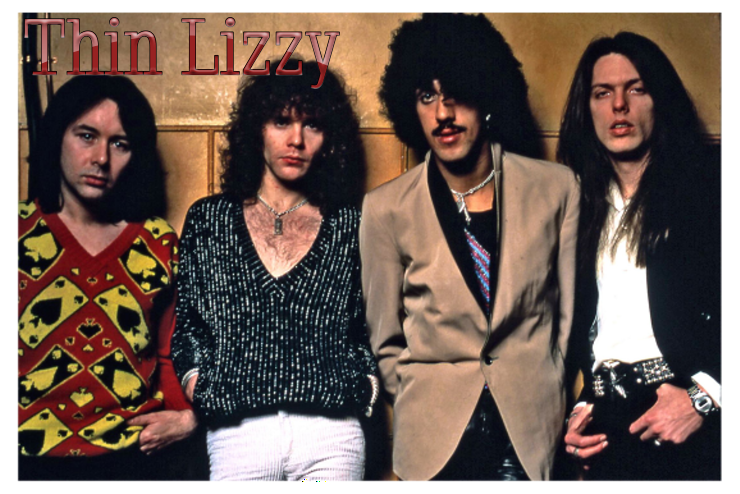
Here is where the fingerprints get impossible to ignore. Iron Maiden built an entire empire around harmonized guitar lines, and Thin Lizzy sits among the bands that helped shape that melodic language. Steve Harris has openly acknowledged Lizzy as an influence, even while pointing more strongly toward Wishbone Ash when discussing the roots of Maiden’s harmony guitar approach. Dave Murray and Adrian Smith took that broader tradition, sped it up, sharpened the edges, and galloped across the eighties with it. Thin Lizzy was not the only blueprint, but its fingerprints are all over the architecture.
Metallica felt the pull too. James Hetfield and company covered “Whiskey in the Jar” and handed a fresh wave of thrash kids a doorway to the source. That version became a Grammy winner, funny enough, introducing millions to a folk melody reborn through Irish grit and distortion. Def Leppard, Alice in Chains, Mastodon, the trail of breadcrumbs runs everywhere once your ears open up to it.
Heavy is the operative word people forget. Drop the needle on “Angel of Death” from the Renegade record. Crank “Thunder and Lightning,” the final studio album, where the riffing turns downright vicious. This was a crew getting harder as it aged, not softer. By the late run Sykes was carving a tone with a real razor in it, mean enough to sit beside whatever the kids in denim were building at the time. Ever really sat with “Cold Sweat”? The thing does not so much play as charge straight at you.
There is serious craft buried under all that muscle, though. The twin parts almost never just ran side by side in tidy parallel. One climbs, the other answers it, both stacking up in thirds until the whole arrangement tilts nearly orchestral. Even the bottom end carried a tune, walking and snarling beneath everything rather than only nailing down the root. Brains bolted onto brawn, basically. That exact blend became part of the vocabulary the New Wave of British Heavy Metal grabbed and tore off with, then later metal players pushed even further. Vivian Campbell and Kirk Hammett have both spoken openly about the mark Thin Lizzy left on their ears. Once you know what to listen for, that Irish DNA starts turning up all over hard rock and metal.
Lynott himself deserves a monument bigger than the one Dublin already raised. Rare charisma, a bass player with genuine pocket, a lyricist quoting cowboy films and Celtic myth inside a single breath. He carried himself like a superstar before the industry decided what that even meant for somebody who looked like him fronting a hard rock outfit in the seventies. Doors were not exactly propped open. He kicked a few off the hinges anyway.
Think about the range on display. “Jailbreak” struts. “Dancing in the Moonlight” swings with soul horns and a grin. “Sun Goes Down” broods in shadow. “Warriors” churns with an aggression that points toward heavier sounds still to come. Few catalogs move that freely between menace, tenderness, and pure celebration without ever sounding scattered. The connective tissue was always Phil, that unmistakable phrasing, the wink hiding behind the danger.
Onstage, they were monsters. “Live and Dangerous” remains one of the greatest concert documents ever pressed to vinyl, arguments about studio overdubs be damned. Interplay between the players crackled. Two axes trading fours, a rhythm section shifting from gallop to groove without blinking, a bandleader working the room like a preacher mid sermon.
So why does history keep shortchanging them? Bad luck accounts for some of it. Lynott died young, in early 1986, before the metal boom he helped influence reached some of its biggest commercial heights. Geography played a part too, since an Irish act never fit neatly into the American or British boxes marketing folks preferred. Mostly, though, it comes down to that one radio staple casting far too long a shadow, especially in America. Folks simply stopped digging.
Summer 2026 is nearly spent, the light going gold earlier each evening, so let these last warm nights carry a real soundtrack. Do the digging. Go past the greatest hits playlist and sit with “Black Rose: A Rock Legend,” a full record fusing traditional Celtic themes to bruising muscle. Give the title track its whole seven minutes, all those shifting sections and dueling leads. Then dig up “Sarah,” the soft one Lynott wrote with Gary Moore for his little girl, and slam it right against the sneer of “Bad Reputation.” Lynott at the center of both, two completely different animals. That album, and the catalog around it, proves the ambition ran leagues beyond airplay.
Every generation of six string slingers owes a quiet tax to these architects. When harmonized twin lead melodies ring out across today’s heaviest acts, from melodic death squads in Gothenburg to festival headliners playing to a hundred thousand fans, part of that DNA traces back to a scrappy bunch out of Dublin who flat refused to play it safe. The template they helped stamp never wore out.
Give them their proper due. Not as a band American radio too often reduced to one giant hit, not as classic radio filler between longer cuts, but as architects. Heavier than the textbooks admit, smarter than the singles suggest, more influential than they are often credited for. Phil and his boys built one of the strongest bridges from blues based swagger into the heavier music that followed, and generations of metal musicians walked across it.
The boys came back to town, sure. What almost nobody mentions is that they arrived carrying part of the blueprint for everything that rolled in after them.
Staff Writer; Terry Poole
This brother brings sharp ears, deep respect, and real passion to every heavy metal riff, rock record, and overlooked gem he covers for TheBRHM… He writes for fans who still believe loud music should have soul, history, and meaning…
One may contact him at TerryP@TheBRHM.com.