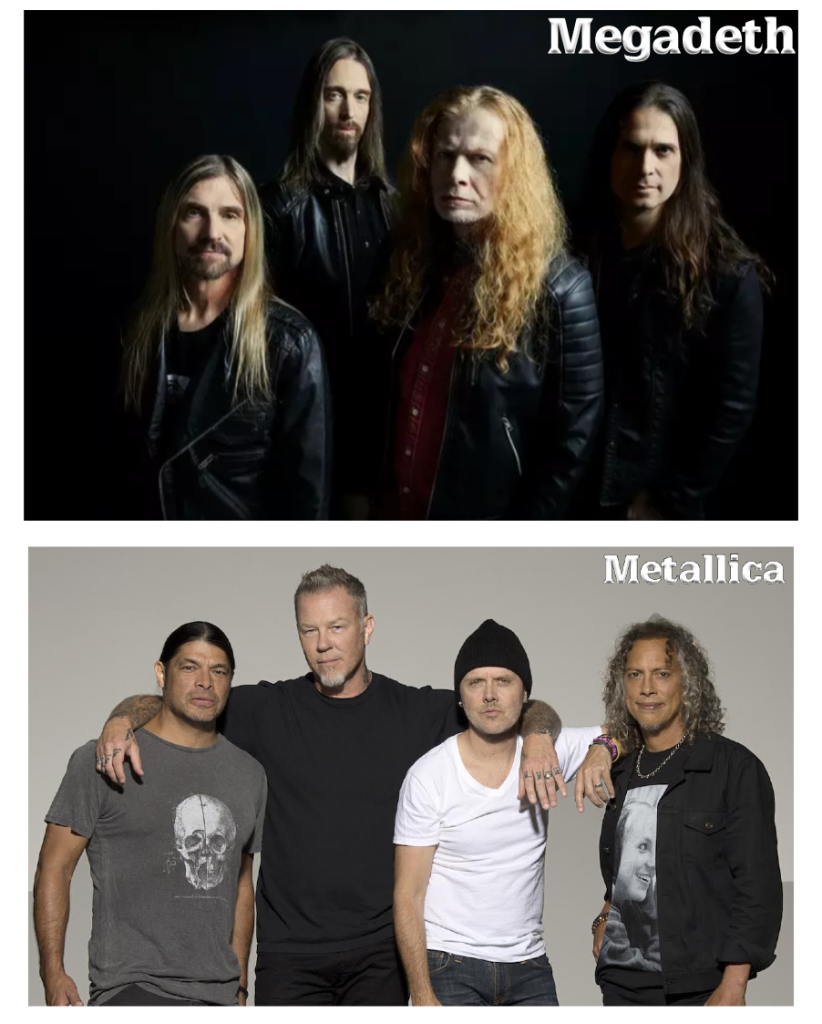
(TheBRHM.com) Drop the needle on Rust in Peace and about ninety seconds in you’ll get everything worth knowing about Megadeth. None of it has a thing to do with Metallica. I figured that out young, back when I was a Black kid falling hard for heavy metal and making it mine. This band was never me chasing the biggest name around. It pulled me in because it got the noise in my head, the anger I didn’t have words for yet, that itch to hear a guitar say the stuff I couldn’t. Mustaine’s music handed me that. And for years people kept squeezing all of it into one tired little question. Is Megadeth as big as Metallica? Man, who cares.
That comparison has followed the band around like a bad smell since the eighties, and honestly it does a disservice to what Mustaine and his crew actually built. Yes, everybody knows the origin story. Mustaine got fired from Metallica, took a Greyhound bus back to Los Angeles seething, and swore he’d build something that would make his old band regret it. That fire is real and you can hear it. But somewhere along the way, folks decided the whole point of Megadeth was to lose a race nobody should’ve been running in the first place. I reject that. Flat out.
Because when I put on Rust in Peace, I’m not thinking about record sales. I’m thinking about how “Holy Wars… The Punishment Due” opens up and just detonates. That intro riff has more information packed into it than some bands manage across a whole album. The way it shifts, the way it stops and reloads and comes back meaner, that’s not a band chasing anybody. That’s a band that found its own language. Marty Friedman’s lead work on that record still sounds like it came from another dimension. His phrasing, those exotic scales he pulled from all over the world and dropped into thrash, nobody was doing that. Nobody sounds like Friedman even now. That’s identity. You can’t fake that or borrow it.
Let’s talk about the guitar for a minute, because this is where the whole “bigger than” argument really falls apart. Metallica writes powerful songs, no argument from me, Hetfield’s right hand is a machine and I respect it. But Mustaine plays and writes like a man trying to fit ten ideas into a space built for three. His riffs are twitchy, technical, restless. They dodge and weave. Put on “Tornado of Souls” and wait for the solo. The one Friedman laid down that guitar players are still picking apart note by note all these years later. It sounds furious and heartbroken somehow, both at once, which shouldn’t even work. That’s the thing with Megadeth though. The magic hides in the small moves, the way a rhythm part ducks around a corner you never saw coming. That’s a specific taste. Some people want the anthem. Some of us want the puzzle. Both can be great without one having to bow to the other.
I grew up getting side-eyed for what I listened to. Dudes who looked like me asked why I wasn’t into what I was “supposed” to be into. White kids at the record store looked surprised I knew my stuff. So I learned early that the whole business of ranking things, of deciding what counts and what’s allowed to matter, is usually somebody trying to control the story. And the endless Megadeth versus Metallica scoreboard has always felt like that same energy to me. It’s a way of never letting the band just exist on its own terms. Peace Sells… But Who’s Buying? doesn’t need a comparison to justify itself. That title track alone, with that bass line everybody recognizes even if they don’t know where it’s from, earned its place in the culture without anybody’s permission.
And here’s what really gets me. Megadeth’s catalog is deep and weird and inconsistent in ways that make it more human, not less. So Far, So Good… So What! has that raw, spitting version of “Anarchy in the U.K.” and the gut punch of “In My Darkest Hour,” whose music Mustaine wrote after learning that Cliff Burton had died. Think about that for a second. His old bandmate passes, and despite all the bitterness surrounding Metallica, grief still poured out of him into a song. That’s not the behavior of somebody purely obsessed with winning. That’s an artist. Countdown to Extinction went a completely different direction, tighter, more accessible, and it worked because the band could actually do that. Youthanasia kept exploring. Even when they stumbled, and they did stumble, the swings were interesting.
People love to bring up the messy years, the lineup changes, the times Mustaine’s mouth got him in trouble, the records that didn’t land. Fine. All of that happened. But a band’s worth isn’t a stock price. Some of my favorite artists made a couple of albums I skip. Doesn’t erase the ones that changed me. Megadeth’s influence spread out into places the sales charts never captured. You hear Mustaine’s fingerprints in tech-death, in progressive metal, in the way a whole generation of guitarists approached rhythm as something aggressive and intricate at once. Bands from Brazil to Sweden to right here in the States picked up that thread and ran. That kind of reach doesn’t show up in a “who’s bigger” argument, and that’s exactly why the argument is useless.
Kirk Hammett crosses my mind now and then, since he’s wrapped up in the whole mess. Mustaine had co-writing credits on songs that landed on Metallica albums after they cut him loose. The bad blood, the interviews, that documentary where he just broke down on camera, all that wreckage is why nobody will let the rivalry rest. But a grown man still aching over something from thirty years back, that should soften how we treat it. Not hand us a scoreboard. Mustaine’s been hauling around the weight of being the guy left behind for a long time already. So why would anybody who actually loves this music want to keep tallying up a game that only exists to poke at his worst day?
Nah. I’d rather celebrate what the man built out of that wound. Megadeth is technical and thorny and political and sometimes uncomfortable and it never once tried to be smooth. That’s the appeal. It’s music with elbows. The music doesn’t hug you. And for a kid who felt like the odd one out even among the odd ones out, that spiky, standoffish quality felt like somewhere I belonged. It told me you can matter without everybody in the room liking you. Being the biggest was never the same as being the truest version of yourself.
So I’m done measuring this band against the ghost of what somebody else did. Rust in Peace stands next to any thrash record ever made and looks it dead in the eye. The guitar work is a genre unto itself. The influence is stitched into music that’s still being made today. That’s the legacy. Not a silver medal. Not a “what if.” A body of work that earned its own seat at the table and never needed anyone to pull the chair out.
Megadeth never had to outgrow Metallica. Nobody handed the band that job, however many times folks tried to pin it on them anyway. And now here we are at the beginning of the end. This past January the band dropped its seventeenth and final record, a self-titled thing, and stepped into a farewell run that could stretch across the next several years. Forty-plus years into this thing, the story is finally moving toward a close on their own terms, which is more than most acts ever get. All Megadeth ever had to do was be Megadeth. Loud, a pain in the neck, and flat-out brilliant in that crooked way of theirs. Done and done. Crank it and stop keeping count.
Staff Writer; Terry Poole
This brother brings sharp ears, deep respect, and real passion to every heavy metal riff, rock record, and overlooked gem he covers for TheBRHM… He writes for fans who still believe loud music should have soul, history, and meaning…
One may contact him at TerryP@TheBRHM.com.