
(TheBRHM.com) There is a band whose name belongs in every serious conversation about American heavy metal, and most people have never heard it. They had everything the moment demanded. And the world still slept on them. Not because they lacked the goods, but because four Black men plugged in and played metal at a time when the industry had no idea what to do with a picture like that.
Sound Barrier came up out of Los Angeles in 1980. Bernie K. on vocals. Spacey T. tearing up the guitar. Stanley E. holding down bass. Dave “Skavido” Brown behind the kit. Bernie K. and Spacey T. first crossed paths grinding in an R&B funk outfit, then decided they wanted something heavier, louder, meaner. So they chased it. Judas Priest, Iron Maiden, Thin Lizzy, even a little Rush in the DNA when it came to musicianship. This was real metal, dual leads and all, not some watered down crossover thing cooked up in a boardroom.
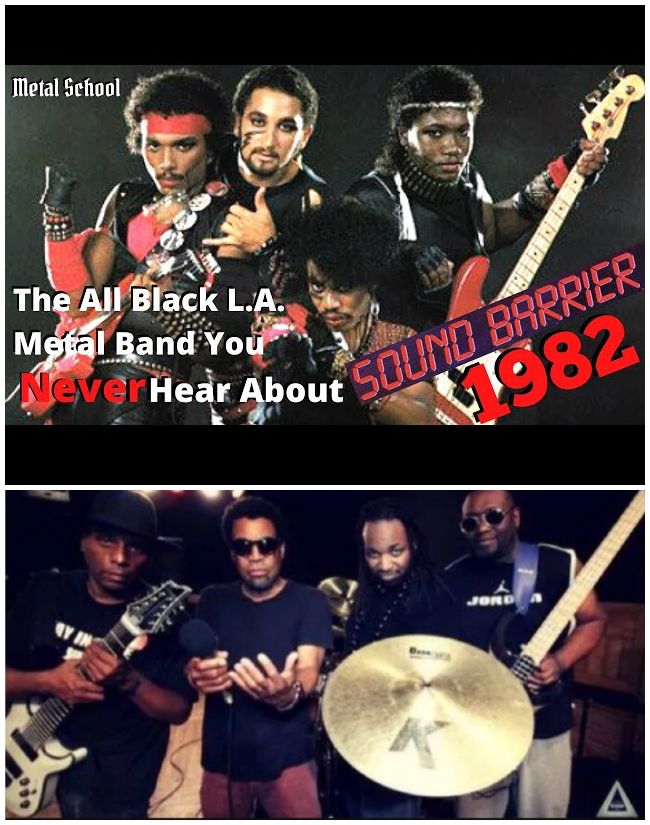
Picture the Sunset Strip back then. Hairspray for days. Marshall stacks stacked to the ceiling. Spandex and bad attitudes everywhere you looked. Sound Barrier walked into that circus with chops most of those Aqua Net bands couldn’t touch, and they looked sharp doing it. They had the sound. They had the stage presence. Spacey T. could flat out play, fluid and nasty in the same breath, the kind of guitarist other guitarists nodded at from the side of the stage.
Then came the part that should have changed their lives. MCA signed them in 1982. A major. Real money, real distribution, real machinery behind the music. Sound Barrier became widely credited as the first all-African-American metal band to land a major-label deal, which in 1982 was no small thing. Their debut, Total Control, dropped in 1983. Nine tracks, melodic where it needed to be, blistering where it counted. By every measure that mattered on paper, these brothers had arrived.
So what happened? The record moved around twelve thousand copies and MCA dropped them. Twelve thousand. For a band with that kind of talent and that kind of shot, that number doesn’t tell a story about the music. It tells a story about everything wrapped around the music.
Here’s where it gets real. A radio programmer in 1983 gets a press photo across his desk. Four Black faces. What does he assume before he even drops the needle? R&B. Funk. Soul. Anything but a band that worships Priest. So the record never sniffs the rock format that would have loved it, and it sure isn’t getting spun on the urban stations either, because it’s loud guitar music that doesn’t fit their lane. No home anywhere. Caught in the gap nobody built a bridge across.
And the label? Marketing a metal band means a specific playbook. Get them in the rock rags. Get the video in rotation. Push the single to album rock radio. Now imagine the promo guy whose whole job is selling to programmers he knows are biased, who maybe carries some of that same baggage himself. Does he fight that fight, or does he let the record die quiet and move on to the next sure thing? Sound Barrier got the deal. What they didn’t get was anybody swinging for them.
You want to talk MTV while we’re here. In those early years, MTV kept a nearly all-white playlist and gave very little space to Black artists. We all know the stories. It took muscle from a major label and a guitar solo from a white rock god before “Beat It” helped crack that wall wide open. A young Black metal band with a modest budget and no leverage? Forget it. The one place a wild looking, hard charging act could have caught fire visually was a door bolted shut from the inside. So the look that should have been an asset never reached the eyeballs that needed to see it.
Genre boxes did the rest of the damage. The industry loves a tidy shelf. Put the artist in a category, hand the category to the right department, collect the check. A Black act gets filed under urban almost on reflex, no matter what’s actually coming out of the speakers. Sound Barrier made heavy metal, full stop, but the system kept trying to read them as something they weren’t. When the box doesn’t fit the music, it’s always the artist who bleeds, never the box.
They didn’t fold up and quit, though. That part I love. After MCA cut them loose, they put out the Born to Rock EP in 1984 on their own Pit Bull imprint. Do it yourself before do it yourself had a name. Then Metal Blade came calling and they cut Speed of Light in 1986, even flipping a Thin Lizzy tune in the process, which felt like a wink to anybody paying attention to where their hearts lived. By then, the original all-Black lineup had already shifted after Stanley E. left and Emil Lech joined on bass. By 1987, the band itself had broken apart, and the music world barely noticed a thing.
Now watch the timing, because it stings. A year or so later, Living Colour walks through a door Sound Barrier spent the decade pushing against. Vernon Reid had the Black Rock Coalition behind him, a movement built specifically to drag this exact conversation into the light, plus a co-sign from a producer with a household name. “Cult of Personality” hits, the Grammy comes, and suddenly the mainstream acts surprised that Black folks play rock, as if Chuck Berry didn’t invent half the vocabulary. Sound Barrier had been saying the same thing years earlier into a room that wasn’t ready to hear it yet. Right message. Too soon. That’s the cruelest spot to stand in, knocking before anybody decides to answer.
The talent never went anywhere, by the way. Spacey T. kept eating. He joined Mother’s Finest and helped make a record literally titled Black Radio Won’t Play This Record, which might be the most honest album name in the history of the format wars. Later he ran with Fishbone for years, touring and recording, putting that fluid menace to work for a whole new crowd. The man’s fingerprints are all over the alternative and funk metal lineage, even when the casual listener never connected the dots back to where it started.
The story gets a little redemption, too, which I needed. In 2017 a reunited Sound Barrier played the Whisky a Go Go under a banner that read Metal Has No Color, and the room was thick with believers. Tom Morello showed up and produced their new single. Corey Glover from Living Colour was there. dUg Pinnick from King’s X stood in the building. A generation of Black rock musicians who came after, paying respect to the cats who took the early shots and ate the early losses. That night the truth finally got said out loud to a crowd that already knew it in their bones.
So why does any of this matter now? Because the thing that buried Sound Barrier was never the riffs and never the songs. It was a machine that couldn’t read a photograph without flinching. The sound was there. The look was there. The chops were undeniable and the major-label shot was real. What failed was an industry that built its shelves before it built any imagination, and a country that kept acting shocked at something it had been told a hundred times already.
I want you to go find Total Control. Put it on loud. Sit with the fact that this was sitting right there in 1983, waiting for somebody brave enough to push it the way it deserved, and nobody did. Then think about every other name we lost the same way, the ones who didn’t get a reunion night or a Morello cameo, the ones who just faded because the gatekeepers couldn’t see past a press photo.
Sound Barrier wasn’t ahead of the music. They were dead even with it. The world was just running late, and four bad brothers from LA paid the bill for everybody else’s lag. Crank it up. Say their names. They earned that much and a whole lot more.
Staff Writer; Bobby Jackson
This brother is dedicated to covering heavy metal and rock music with depth, respect, and cultural awareness. His writing highlights Black heavy metal and rock artists while also celebrating the genre’s broader legacy, influence, and artistic power.
Contact him at: BobbyJ@TheBRHM.com.