
(TheBRHM.com) There are certain bands whose influence runs far deeper than their record sales ever suggested, and Black Death belongs near the top of that list. Long before the rest of us had the language to describe what they were doing, four young men out of Cleveland were quietly rewriting the rulebook on who got to play this music and what it could sound like. Put bluntly, they dismantled nearly every assumption about who this genre belonged to, and they did it years before most of today’s celebrated crossover heroes had even figured out which way to hold a guitar.
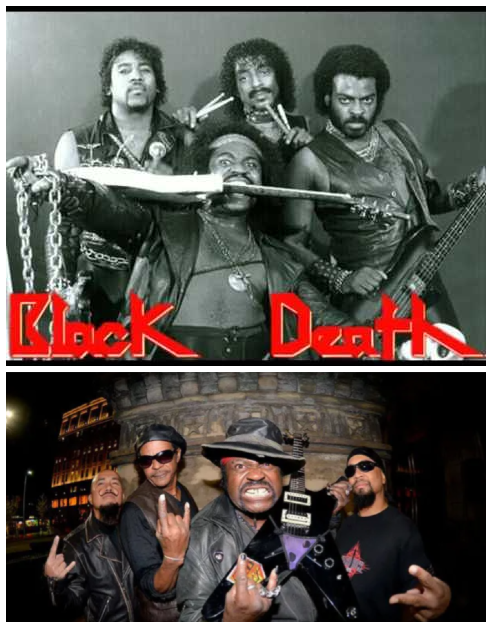
Black Death. Say the name slow and let it sit. These dudes came together in 1977, so picture it. Disco running the airwaves, everybody out on the floor doing the hustle, and meanwhile down in the Rust Belt you got Greg Hicks, Phil Bullard, and Clayborn Pinkins building something loud and ugly and beautiful with no lane to even drive it in. No name yet. No singer for a stretch. Just three Black men making a racket nobody had given them permission to make. Sit with how bold that is. There was no roadmap. Nobody to copy off of. They were drawing the picture and inventing the colors at the same time.
Then Siki Spacek walked through the door, and the whole thing snapped into focus. Real name Reginald Gamble, but the man renamed himself like a comic villain and backed up every syllable. He turned into the voice, the writer, the lead riff machine, the engine that pulled the whole train. And here’s the part that gets me grinning every single time. The fellas he linked up with didn’t really know what they were getting into. Siki had to teach them. Sat them down with Scorpions songs first. Then he dragged the crew to a Judas Priest concert just so they could feel in their chest what he was already hearing in his head. You understand what kind of belief that takes? You’re chasing a sound nobody around you recognizes, and instead of folding, you school your own people until they can hand it back to you.
So now let me get to why I titled this thing the way I did. Ahead of their time. And I don’t mean by a year or two. I mean these brothers were operating in a future the rest of us hadn’t booked tickets for.
Think about the timeline real careful. When D.R.I. and Suicidal Tendencies and that whole crossover wave finally taught the hardcore kids how to bang their heads, when speed and punk officially shook hands and the magazines acted like somebody had split the atom, Cleveland’s finest had already been smashing those worlds together in sweaty little dive bars for years. The self-titled record didn’t even land until 1984 on Auburn Records, which is its own kind of perfect. But the songs on it were older than that. Road-tested. Beaten into shape on stage long before any tape rolled.
And what does that record actually sound like? It runs. It runs hard. You hear thrash before the word thrash was on everybody’s lips. You hear speed that’s about to trip over its own feet and somehow never does. You hear punk in the snot and the swagger and the way the whole thing refuses to be polite. The production is rough as a gravel road, no budget, no studio gloss, like the tape itself was a little scared of them. And honest to God that’s the magic. That dirt under the fingernails is the point.
Reach for a track called “The Scream of the Iron Messiah” and brace yourself, because that’s the four-piece at full sprint, riffs tumbling over each other with Siki’s voice clawing up out of his usual deep growl into something almost feral. Then you got “Streetwalker,” which is where the lyrics earn their keep. That ain’t dungeons and dragons fantasy fluff. That’s life on the corner, the grind, the hustle, the stuff Siki could see right outside the window. Long before a lot of these subgenres pretended to discover that you could put real street truth inside heavy music, this Ohio crew was already doing it without making a press release about it. “Night of the Living Death” and “Fear No Evil” round it out, and the whole platter holds together like one long fever.
Now I can’t tell this story honest and skip the heartbreak, because there’s a heavy one. Their first bass player, Clayborn Pinkins, got murdered in 1979. Shot dead. The man went to pick up his lady from a chicken spot over where Broadway meets Union, and that was it. Gone, right at the start, before he ever got to watch what they’d become. That kind of loss could have buried the whole project. Folks have quit over a whole lot less. Darrell Harris eventually slid in on bass and locked down the lineup you hear on the album, but you best believe that shadow followed the music.
And here’s a thing that knots my stomach a little. For all that vision, for all that fire, they never really busted out of their hometown. They opened for cats like Rick Derringer, Anvil, and Helix. Real rooms, real crowds. But the bigger stages, the major label money, the world tour, none of it came knocking. They watched other acts who looked a little more familiar, a little more expected, walk right past them and grab the deals. You want to talk about a tax that doesn’t show up on any receipt. Being first and being unfamiliar at the same time can cost a man everything but the satisfaction of having done it.
You’ll catch some debate about whether they were truly the very first all African American crew in the genre. Sound Barrier, another pioneering all-Black heavy metal band, released a full-length record, Total Control, in 1983, one year before Black Death’s 1984 album. Fair enough. But Black Death’s roots go back to 1977, and most heads who know the history still give these Cleveland boys the crown for arriving on the scene first. Siki himself never made the whole thing about color anyway. He’s got this great line about how being all dark skinned wasn’t some plan they cooked up in a back room. To him it was simply how the lineup turned out, and a coloring book stays a coloring book no matter what shades you fill it with. He just wanted to build the ultimate heavy band, the kind that could hit every emotion the way Hendrix and Sabbath and the rest hit theirs. Race was real, he knew the world made it real, but the mission was the music first.
They went quiet around 1988 and stayed mostly silent for two long decades. When the dust finally settled there was even a little family feud over the name, Siki running one camp and Greg another, the way these old stories always seem to fracture. Spacek’s version eventually rolled on as Black Death Resurrected. But the part that warms me is what happened to that lone old album. Hells Headbangers got it reissued, put it back in physical form, and all of a sudden a new generation started catching on. Decibel wrote it up. Kerrang gave it ink. Collectors started chasing the original pressing like buried treasure, because that’s exactly what it is.
So when I say they were ahead of their time, here’s what I really mean. The blend they were brewing in 1977, the way thrash and speed and punk attitude and honest social truth all got thrown in one pot, became the recipe a dozen famous outfits would later get rich and celebrated for. These dudes were the prototype. The proof of concept nobody acknowledged. They showed it could be done, and then the spotlight swung over their heads and landed on the folks who arrived after the door was already open.
And maybe the sweetest part, for somebody like me, is what their whole existence quietly says back to that uncle at the cookout. Brothers absolutely do rock. Brothers helped build the thing. Black men were in the engine room of heavy music from the jump, sweating and bleeding and inventing, whether the history books bothered to write it down or not.
Go put that record on. Crank it loud enough to annoy your neighbors. Then ask yourself how something this raw, this fearless, this far out in front, ever got left in the dark this long. Black Death earned their flowers a long, long time ago. The least we can do is finally hand them over.
Staff Writer; Bobby Jackson
This brother is dedicated to covering heavy metal and rock music with depth, respect, and cultural awareness. His writing highlights Black heavy metal and rock artists while also celebrating the genre’s broader legacy, influence, and artistic power.
Contact him at: BobbyJ@TheBRHM.com.