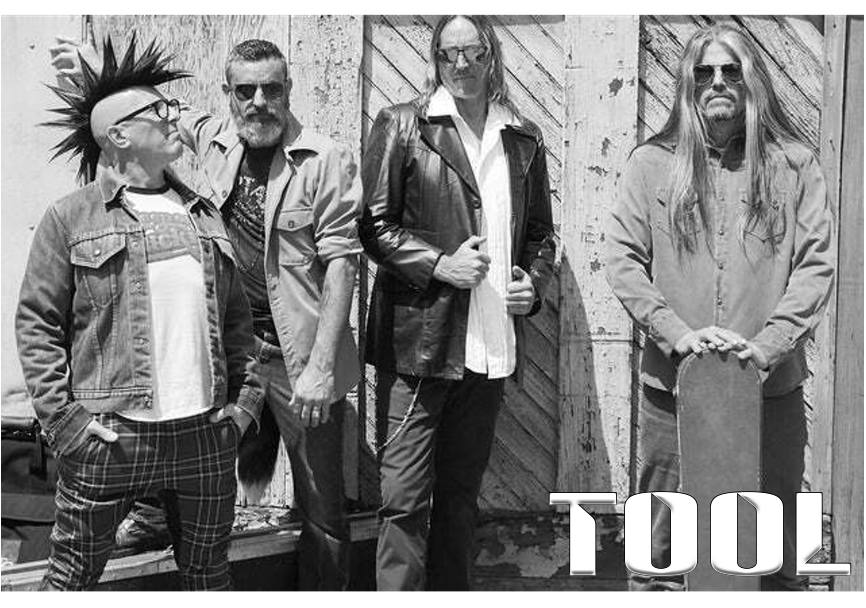
(TheBRHM.com) There is a lazy piece of conventional wisdom that trails heavy metal around like a bad smell, the notion that once a band gets smart it stops being able to hurt you. Add a philosophy reading list, a few sprawling arrangements, some odd meters, and supposedly you have traded the pit for a lecture hall. Tool has spent decades making that assumption look ridiculous. The four of them proved you could think in spirals and still knock the wind clean out of somebody.
Consider “Schism” for a second. Music students have filled notebooks trying to map its meter, with its famous riff moving between 5/8 and 7/8 and the song shifting meter dozens of times across its length. Justin Chancellor once described part of its rhythmic feel as moving from six into “six-and-a-half.” On paper it reads as homework. Down on a general admission floor it does something else entirely, because Chancellor’s bass tone climbs right up your sternum and sits there. Nobody in that crowd is counting. Their bodies already know the count without asking permission, which is the core miracle the four of them built a career on. Cleverness and brute physical force were not meant to be an either or proposition, and somebody needed to say so with a low end this filthy.
Go back to the start and the path tracks clean. Undertow dropped in 1993 and hit like a fist wrapped in barbed wire. “Sober” and “Prison Sex” dug straight into pain and abuse with nothing dressing it up. Not much was complicated yet. They already carried a hunger for structure that the grunge crowd clogging the early nineties mostly lacked. Then Ænima landed in 1996 and blew the doors wide. Long form meditations shared space with two minute gut shots, and the record never flinched at the whiplash. Growth of that sort usually costs a group its edge. The four somehow got sharper as the writing got stranger.
Danny Carey might be the strongest argument in the entire Tool catalog. Watch him play “Lateralus” and you are watching him drive a composition built partly around Fibonacci patterns, with sections moving through 9/8, 8/8, and 7/8 while Maynard James Keenan’s syllables climb and fall through the sequence 1, 1, 2, 3, 5, 8. Sacred geometry, the golden spiral, the sort of thing that sounds insufferable the moment you type it out. Then the drop lands deep into the track and none of the math matters anymore. Your chest caves. Carey studied theosophy and drew a Unicursal Hexagram behind his rig, and he still swings harder than most cats who barely cracked a book. Intellect did nothing to dull his right foot. If anything it sharpened the blade. His hands run competing rhythms in the same instant, a trick owed as much to jazz cats and tabla masters as to any veteran of the pit.
Look at what the songs are actually about. “Forty Six & 2” draws on Carl Jung’s concept of the shadow self and a fringe evolutionary idea associated with New Age writer Drunvalo Melchizedek, the belief that humanity might advance by adding two chromosomes to its existing 46. “Ænema” takes a shovel to Los Angeles and prays the ocean swallows it whole, half comedy and half fury, drawing heavily from the worldview of comedian Bill Hicks. Heady material for a corner of heavy metal that fans assume peaks at demons and volume. Yet none of it arrives dry. Maynard delivers Jungian psychology in the voice of a man being exorcised, and the riff churning under “Forty Six & 2” grinds slow enough to register as geological. Big thoughts land differently when welded to something this crushing.
None of that ambition would matter if it stayed locked in the skull. That is the part critics of prog never quite grasp. Complexity in the wrong hands becomes decoration, a way of flaunting chops nobody asked to see. In Adam Jones and company’s grip it became a delivery system for dread, awe, and grief, the enormous feelings that plainer structures sometimes cannot hold. “Right in Two” watches angels marvel at human cruelty over a pulse that keeps slipping the ground out beneath you. The music keeps trembling and the words tremble right along with it. Form and feeling move as a single nervous system, and a listener registers the philosophy in the body long before the brain translates a syllable of it.
The stage is where the argument settles for good. Adam Jones built a visual world around these performances, stop motion nightmares and writhing clay figures thrown across a platform lit like a fever dream. Ten thousand strangers pack into near darkness for a fourteen minute epic. Phones stay put away under the band’s famously strict no-recording policy, so most of the crowd experiences the spectacle without staring through a screen. You feel the floor flex when a riff finally lands. Prog earned a reputation as a spectator sport, the kind of show you nod along to at a safe distance with your arms folded. Try folding your arms through “Pneuma” the moment Chancellor and Carey lock into that groove. Justin lays down bass lines that most players would need two hands and a prayer to imitate. Intelligence and impact are not fighting each other up on that riser. They are the same fist.
Part of what sells the entire endeavor is patience. Five years, then thirteen years crawled past between records at a certain stretch, an eternity in an industry built on churn. When Fear Inoculum finally surfaced in 2019 it opened on a ten minute title cut and refused to apologize for a heartbeat of it. Radio could not find a foothold. Did not matter. The devotion around this catalog runs far deeper than any hit single that might have been trimmed for airplay. Maynard splits his time across A Perfect Circle, Puscifer, and a winery out in Arizona. The guy clearly hates repeating himself. Nobody in this outfit rushes a record, and the crowd has learned to sit tight for it. They are still headlining major festivals in 2026, and the machinery has not stopped. Danny Carey said in February that he hoped new Tool music would arrive in 2027, with the band already deep into work on ideas for what comes next.
Here is the notion that gets lost in the argument. Sterility in heavy metal usually grows out of a shortage of stakes, not a surplus of ideas. Plenty of dumb, simple tunes feel plastic and dead on arrival. A tangled arrangement, by contrast, can hit with the force of open heart surgery. What separates the cold from the living is whether a heartbeat survives underneath the architecture, and Tool refused to let the blueprint smother that pulse. “Jambi” swaggers. “Vicarious” seethes. “The Grudge” builds toward a scream from Maynard that could strip paint off a wall. Odd meters did not neuter any of it. They just handed the fury a stranger, more interesting cage to rattle.
The lesson Tool keeps proving is bigger than any one band. Choosing between the mind and the gut turns out to be a false start, a fork in the road that was never actually there. Sanding your teeth down does not make you sound smart, and playing dumb has yet to make anybody hit harder. A whole generation of heavy metal bands grew up understanding that permission, from Gojira through Meshuggah down to a hundred lesser known crews chasing the same tension. Somewhere a kid is hearing “Lateralus” spiral open for the first time tonight, feeling the floor tilt, clueless about Fibonacci and no worse for missing it. The body understood before the mind ever caught up. That has always been the point.
Staff Writer; Terry Poole
This brother brings sharp ears, deep respect, and real passion to every heavy metal riff, rock record, and overlooked gem he covers for TheBRHM… He writes for fans who still believe loud music should have soul, history, and meaning…
One may contact him at TerryP@TheBRHM.com.